Table For Ghost
ROLE
Designer (Gameplay, System, UI, Mechanical & Technical)
Programmer
DESCRIPTION
Play as a member of a restaurant team responsible for managing the pass/boarding station.
Your job is to handle all customer orders, ensure everyone is properly served, and meet all their requirements within a time limit.
As you progress through different levels, you’ll also uncover more of the story along the way.
YEAR
2026
GENRE
2D simulation puzzle singleplayer
PLATFORM
PC (TBD)
Engine used
Unreal Engine 5
Gameplay Showcase
This is just a footage of the internal demo. It is not the final product
Creative Process
Concept
The original idea comes from my work experience in a fine dining restaurant. In addition to common roles such as running and section service, I found managing the pass/boarding station particularly engaging. Staff in this position are responsible for organising all customer orders, ensuring each dish is correctly plated with the appropriate tools, sides, and occasionally specific toppings. They also take care of minor tasks like clearing food waste.
I believe this concept lends itself well to a game. It would challenge players in time management, multitasking, and cognitive load handling. Based on this, I decided to explore the idea further and began working on the core design pillars.
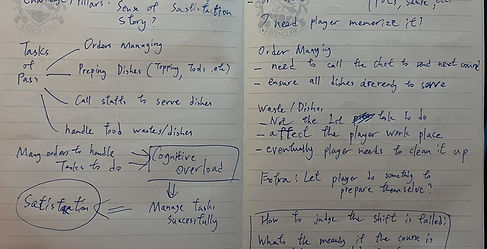
Notes on the conceptualization of the game
Design Pillars
Cognitive Overload Challenge
The game presents players with a continuous stream of dynamic information—order details, dish-specific requirements, unexpected events, etc. Players must react swiftly, balancing time management, multitasking, and decision-making under pressure. This offers a stimulating challenge that tests and develops the player’s ability to manage cognitive load.
Sense of Satisfaction
Successfully completing tasks—especially during intense, high-pressure moments like peak service—can give players a strong sense of achievement. As the number of pending orders decreases, players feel the shift in pace and anticipate the level's conclusion. Combined with meaningful rewards such as story progression and in-game currency, this creates a rewarding feedback loop that encourages continued play.
Engaging Storyline
Since the core gameplay loop can be repetitive, a compelling, evolving narrative helps maintain player interest. Gradually introducing new features through more challenging levels is essential, but pairing this with a story influenced by the player's performance adds further depth. A branching plot or character-driven narrative encourages replayability and emotional investment in the game world.
Gameplay Loop
Pre-Level Story
Level Begins
Customers & Orders Generate
Prepare other requirement while waiting for dishes
Gather all required dishes from the ticket and serve
Complete mini-tasks based on triggered events
Story events
*Simulate the customer flow of a restaurant day*Events occur in a non-linear order
Level Ends, displaying results and income
Post-Level Story

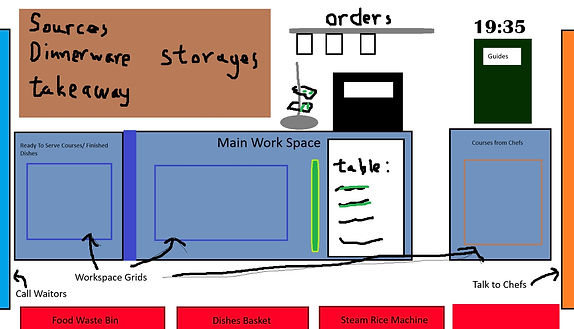
Gameplay UI Concept
Responsible For
System and Mechanical Design:
Player Workspace and Actions
-
A grid system manages all in-game items, emphasising space management. Players must account for the size of items (e.g., dishes, utensils) and organise the workspace effectively to serve meals.
-
With a point-and-click interface, player actions are designed to be simple yet varied. Beyond moving items and assembling dishes, quick-time events add variety and a more interactive, engaging gameplay experience.
-
As the game progresses, dirty dishes and food waste begin to occupy grid space. Players must regularly clear these to keep operations running smoothly.


Level actors and grid systems, UI for player's actions
Customer and Order Generation System
-
The system mimics customer flow throughout the day—simplified but inspired by real-life restaurant dynamics. Customer generation isn’t entirely random; it depends on factors such as in-game time, current customer count, and difficulty level. For example, fewer new customers appear as the restaurant nears full capacity. This allows better difficulty balancing and a more realistic service flow.
-
Time management is central: players must juggle customer wait times, dish preparation, and dining durations. The system reduces idle time while providing room to react and plan, making gameplay more engaging.
-
Customers have diverse demands—ranging from dish types to number of courses—ensuring each playthrough feels fresh, even within the same level or difficulty setting.

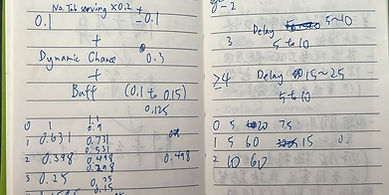
Testing different values and equations for generating customer
Performance and Result Evaluation System
-
Players can make a range of mistakes, from failing to serve a table in time to missing required components. Some may attempt to exploit the system to avoid failure.
To counter this, a performance-tracking system goes beyond binary success/failure (e.g., “on-time delivery” or “all items served”). It logs performance throughout the game, influencing both rewards and story progression, thereby deepening investment in gameplay and narrative.
Event Trigger System (Based on In-game Time)
-
To make each level feel distinct, certain story moments and unique customer appearances are tied to in-game time. Each level has a set list of time-triggered events. These can enhance narrative depth, introduce special orders, or shift difficulty dynamically—providing variety and ongoing challenge.
UI & Technical Design:
-
Given the game’s reliance on point-and-click mechanics and cognitive load management, the UI is critical. A clean and intuitive interface enhances both control and gameplay experience.
-
The MoSCoW method was used to prioritise UI elements:
-
Must Have: Always-visible information, such as current orders and items on the workspace
-
Should Have: A helpful table layout to aid dish delivery
-
Could Have: An optional visual overview of the restaurant’s state, used as a reward system reflecting performance
-
-
All UI components are designed to be clear, well-structured, and in line with the game’s art direction.
-
Technically, a solid foundation was required. Code and Blueprints were designed to enable smooth system interaction. The architecture is modular and scalable to allow for future updates or feature additions.


UI Design Changes along the development
Gameplay Testing:
-
Several playtesting sessions were held to gather feedback on controls, user experience, mechanics, and difficulty.
-
These sessions were instrumental in refining the direction of development, highlighting what players found engaging or confusing.
-
Key insights included the need to improve order ticket readability during fast-paced sections and to streamline gameplay by reducing unnecessary actions—crucial in a game that demands quick thinking and reactions.
-

Gameplay testing question draft
Issues and Solutions
Adjustments Based on Playtesting Feedback
As noted, several rounds of testing were conducted. While the feedback was invaluable, it wasn’t always easy to act on.
At times, player suggestions conflicted with the original design vision. These cases required more than value tweaks—they demanded core mechanic changes or alternative approaches that could satisfy both the vision and player expectations.
Subsequent playtesting rounds helped validate the changes and confirm the game was on the right track.
Balancing Difficulty
The game’s core systems include an element of randomness, which can make difficulty levels inconsistent. The number of arriving customers or simultaneous orders can vary unpredictably.
While value adjustments during testing can help, they’re time-intensive. A better solution was to integrate the Event Trigger System, allowing specific customers to appear at set times.
By combining scheduled and random events, the system smooths out difficulty spikes while keeping gameplay dynamic. It also helps make each level feel more intentional and unique.
Still In Development
Demo is planned for release in mid-2026.